
Here is a paradox worth considering. By age 50, many adults already have coronary plaque. By age 60, it becomes common. By age 70, it is present in a substantial majority of men and many women. Yet most have never experienced a heart attack or stroke.
If coronary disease has already started in so many people, should prevention focus only on finding it with greater precision? Or should we put more energy into preventing the complications that matter most?
Heart disease often begins long before symptoms
Atherosclerosis is the gradual accumulation of plaque in artery walls. It commonly develops silently over decades. Someone can feel completely well even while disease is present.
The first graph compares men and women at ages 50, 60, and 70, with and without metabolic syndrome. This is a combination of factors such as abdominal obesity, high blood pressure, raised blood sugar, high triglycerides, and low HDL cholesterol.
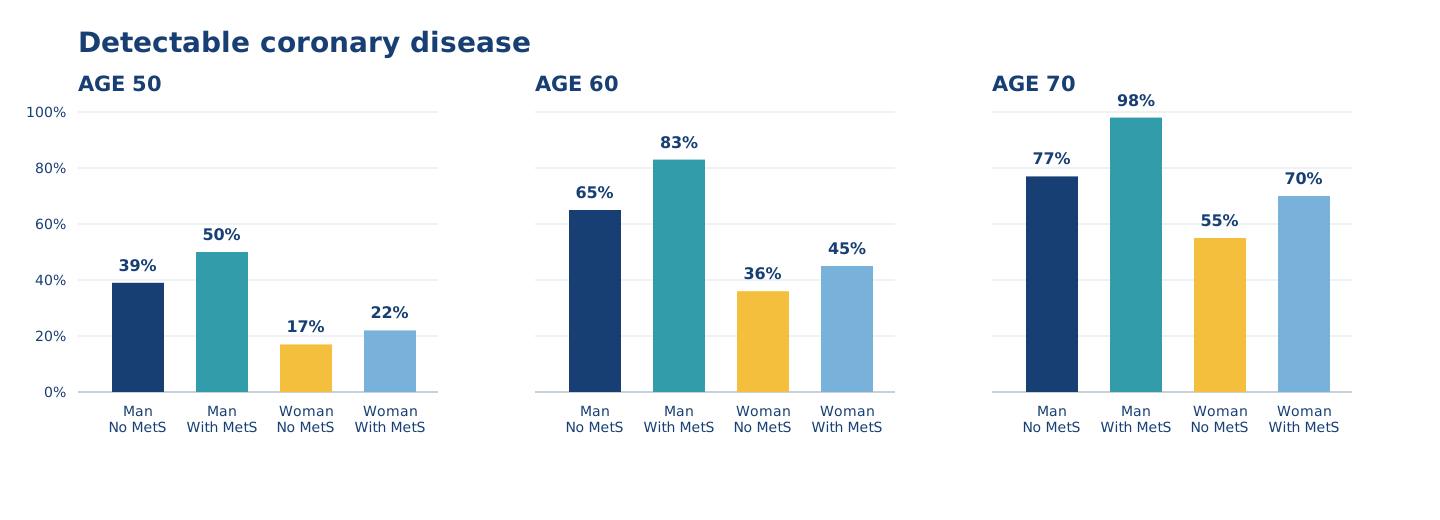
Figure 1. Detectable coronary disease by age. Illustrative plaque-prevalence estimates for men and women with and without metabolic syndrome (MetS). Age- and sex-specific CCTA findings were adjusted using a published MetS-associated plaque ratio. These are modeled population illustrations, not individual diagnostic probabilities. [1–3]
Age and sex already tell us a great deal. Metabolic syndrome adds concern, but aging has a powerful influence on the likelihood that plaque is present. Even adults without metabolic syndrome may have substantial plaque by their seventies.
This does not mean prevention should begin at age 50. It should begin before disease develops, when healthier habits can reduce cumulative exposure to risk factors.
Having plaque is not the same as having an adverse cardiac event (e.g., heart attack)
Coronary plaque may remain silent for years. Many heart attacks begin when a plaque ruptures and a blood clot forms in the body’s attempt to heal the injury. Most heart-attacks originate from small plaques (e.g., <10% blockage), not large plaques. An analogy I often raise with my patients is one of volcanic mountains. Not all mountains are volcanic. And the ones that are volcanic are not necessarily the ones that are volcanic. For example, Mount Everest is large, but no longer volcanic. The presence of plaque, however small, raises concern that plaque rupture may arise. But plaque rupture is not inevitable.
The second figure tells the other half of the story. It illustrates the estimated chance of a heart attack, stroke, or cardiovascular death over the next 10 years for the same age, sex, and metabolic-risk profiles.
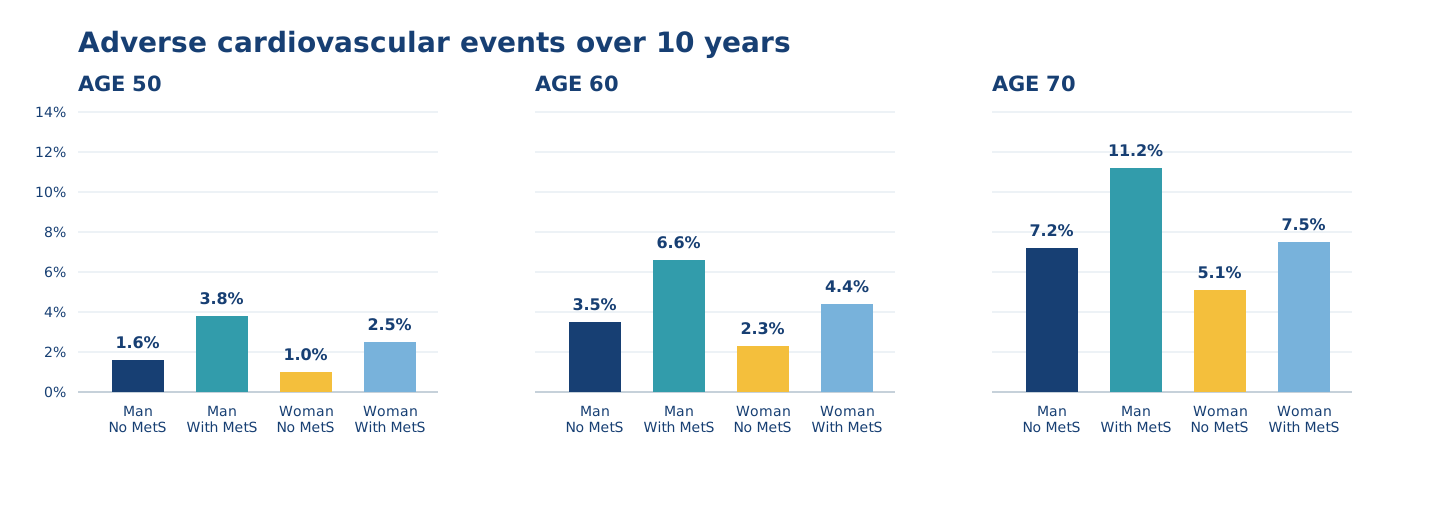
Figure 2. Adverse cardiovascular events over 10 years. AHA PREVENT-ASCVD base-equation estimates for illustrative untreated, nonsmoking adults at ages 50, 60, and 70. Profiles differ by sex, blood pressure, and lipid levels, with other model assumptions held constant. These are predicted event probabilities, not observed rates or consequences directly attributable to MetS. [4]
The event probabilities rise with age, but are far lower than the prevalence of plaque. Disease may already be present, yet there remains a meaningful opportunity to prevent heart attacks, strokes, and cardiovascular death.
Are we missing the forest for the trees?
Cardiovascular risk calculators, coronary calcium scans, CT angiography, and newer biomarkers can all be valuable. They are especially useful when results would change a treatment decision, including whether to start or intensify cholesterol-lowering therapy. [5]
But imagine a 60-year-old with hypertension, abnormal cholesterol, abdominal obesity, and little physical activity. Before ordering another test, we already know that several modifiable risk factors deserve attention.
Could imaging refine the estimate? Certainly. But if the recommended prevention is already clear, the bigger question may be whether the patient can start and sustain it.
Exercise changes what happens next
Exercise is especially important because it can improve cardiovascular fitness, blood pressure, glucose regulation, and other factors associated with fewer cardiovascular events. Large population studies associate regular physical activity with meaningful reductions in cardiovascular events and mortality, although the magnitude varies by activity dose and outcome. [6]
Nevertheless, Canadian accelerometer data found that only 33% of adults ages 60–79 met the recommendation of 150 minutes of moderate-to-vigorous physical activity per week. [7]
This is the know–do gap. We already understand that exercise matters. The harder challenge is helping people achieve an appropriate dose and continue despite pain, fear, competing priorities, or changing health.
From risk recognition to risk activation
At My Heart Fitness™, we think about exercise through four connected functions: Prescribe, Activate, Monitor, and Respond. This means giving people a realistic exercise dose, helping them begin, measuring progress, and adjusting support when barriers arise.
More precise risk assessment will always have a place. But prevention is not complete when a risk score is calculated or a plaque is identified. It becomes meaningful when proven interventions are put into practice.
Frequently Asked Questions
Can I have coronary disease without symptoms?
Yes. Plaque can develop silently for decades, and many people have detectable disease while feeling well.
Does plaque mean I will have a heart attack?
No. Plaque increases risk, but it does not make a heart attack inevitable. Risk-factor management can reduce the chance of complications.
Does everyone need a calcium scan or coronary CT?
No. Imaging is most useful when its findings are likely to change care. Symptoms, medical history, and individual circumstances matter.
Can exercise help after coronary disease has started?
Yes. Exercise may not eliminate existing plaque, but it can improve cardiovascular health and help reduce future risk.
When should preventive habits begin?
Ideally early in life. The aim is to build healthy habits before plaque develops and to continue them as risk changes with age.
The bottom line
Age strongly shapes the likelihood that coronary disease has begun. But it does not dictate whether a heart attack or stroke must follow. That is the paradox of prevention.
Understanding risk is important. Acting on it is where prevention begins.
Calculate / Understand Your Risk → | Learn More About My Heart Fitness™ →
References and figure notes
Larsen AF et al. Gender-related risk of myocardial infarction and subclinical coronary atherosclerosis: a Danish population cohort study. European Heart Journal. 2026. doi:10.1093/eurheartj/ehag612. https://doi.org/10.1093/eurheartj/ehag612
Tattersall MC et al. Incidental Coronary Artery Calcium on Chest CT in Persons Without Known ASCVD. JAMA Internal Medicine. 2023. doi:10.1001/jamainternmed.2023.3317. https://doi.org/10.1001/jamainternmed.2023.3317
Kim LK et al. Impact of metabolic syndrome on the progression of coronary calcium and coronary artery disease assessed by repeated cardiac computed tomography scans. Cardiovascular Diabetology. 2016;15:92. doi:10.1186/s12933-016-0404-7. https://doi.org/10.1186/s12933-016-0404-7
Khan SS et al. Development and Validation of the American Heart Association PREVENT Equations. Circulation. 2024;149:430–449. doi:10.1161/CIRCULATIONAHA.123.067626. https://doi.org/10.1161/CIRCULATIONAHA.123.067626
2026 ACC/AHA Multisociety Guideline on the Management of Dyslipidemia. Circulation. 2026. doi:10.1161/CIR.0000000000001423. https://doi.org/10.1161/CIR.0000000000001423
2018 Physical Activity Guidelines Advisory Committee. Scientific Report. U.S. Department of Health and Human Services. 2018. https://odphp.health.gov/our-work/nutrition-physical-activity/physical-activity-guidelines/current-guidelines/scientific-report
Statistics Canada. Canadian Health Measures Survey: Activity Monitor Data, 2018–2019. September 2021. https://www150.statcan.gc.ca/n1/daily-quotidien/210901/dq210901c-eng.htm